 As I mentioned, I planned to try 100 new (to me) fruits while in Colombia. Here they are.
Uchuva (cape gooseberry/yellow berry): These cherry-sized yellow fruit inside a paper cover (they look like small yellow tomatillos) have an aroma that I can’t describe (a subtle tomato-ish aroma), are slightly sour, and have a tomato-like texture. 
Lulo: This fruit is unique to this part of the world (grows in Ecuador and Peru as well). The Colombians have really made it part of their daily juice selection (fresh juice is a part of daily life here). The lulo looks like a tomato but is super sour so only used for juice. The juice is greenish in color even though the fruit is orange. 
Pitaya (yellow dragon fruit): This fruit could change the world. I call it the “110-minute fruit”… as in, you know where you will be 110 minutes after you’ve eaten it. I like to scoop out the insides sort of like eating a kiwi. It is part of the cactus family. 
Maracuya (passion fruit): When I went on the fruit tour, I learned that the passion fruit sold in the U.S. is the brown version created by mixing a “mom” and a “dad” fruit. In the photo, the big round greenish one on the right is the “mom” and the long narrow one on the left is the “dad” (called a “caruba”) and the one in the center is the one I think of as a passion fruit.
Tree tomato: I tried three different kinds of tree tomato in Colombia. They don’t have much flavor and look like long narrow tomatoes. 
Chirimoya (custard apple): This green pear shaped fruit that looks a bit like an artichoke is a surprise. 
Kumquat: Looks like a grape-sized orange. Supposedly you can eat it, rind and all. I find it very bitter.
Papayuela. The only fruit that must be boiled with sugar before consumption.
Orange: The oranges used for Colombia are often green on the outside and orange on the inside. And sweet.

Mandarin: I mention these because the juice is great. Most of the mandarins I tried in Colombia were in juice form. When I would go to my favorite market, Paloquemao, the vendors would often give me a free mandarin. I appreciate the freebie but really I don’t like the mandarins because they are too papery and fibrous. But, great as juice! And so incredibly orange colored (the green juice in the back is feijoa – mentioned later)!
Zapote: Baseball size and dirt-colored. Inside is the texture of a pumpkin and it is bright orange. This is just one of the fruits you can try on the fruit tour in Bogota. 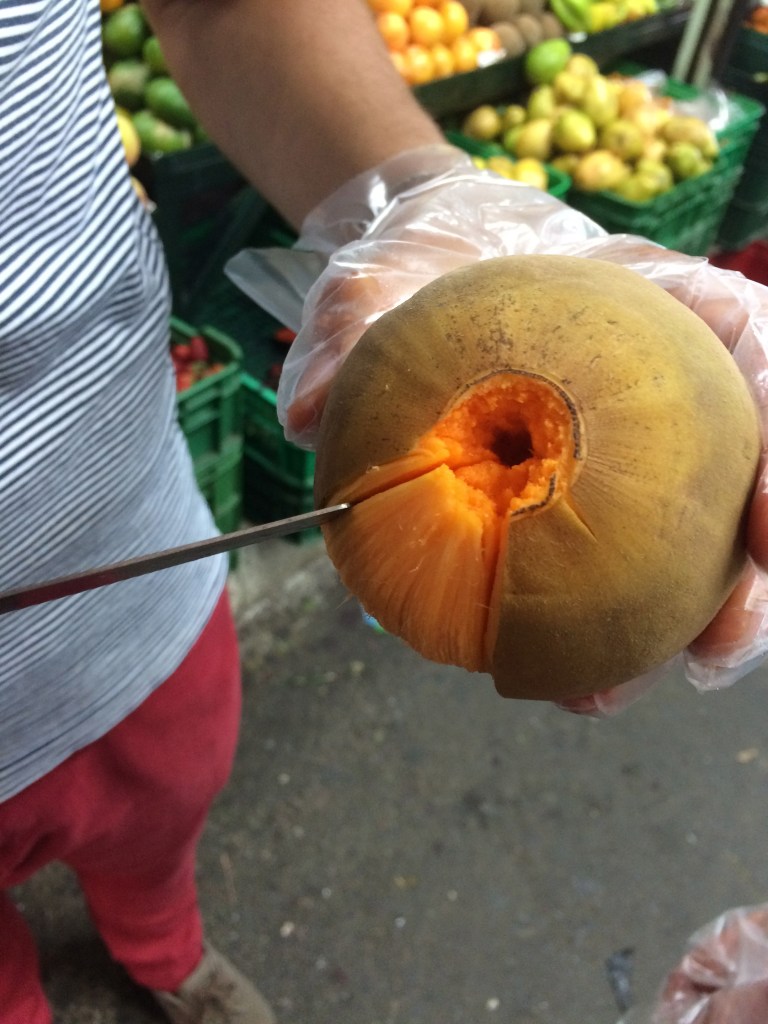
Obos: It looks like an olive and one chews around the hard seed inside. It seems like a lot of work for what you get.
Mamoncillo: Little round hard fruit a bit like lychee but without the same aroma.
Curuba zanahoria: The fruit from a palm tree. It’s a bit like a pumpkin. It needs salt, sugar, and lime juice… is it worth it?
Feijoa (pineapple guava/guavasteen): It tastes like kiwi with a soapy aroma. Not so good for those who don’t like cilantro. Used mostly for juice. Named for a Brazilian explorer.
Guayaba araca (wild acidic guava): These are yellowish and the size of an apple. The aroma of these led me to them in the produce section. Inside the flesh is pale custard color with flesh like a peach. But, they are super sour. Once I read about it, I found out that it needs to have sugar added and it needs to be diluted to 1 part juice to 10 parts water.
Granadilla: This was the go-to fruit for Colombian school kids because this is a sturdy fruit (and apparently the kids would smash it against their forehead to crack it open). 
Guamas: looks like a mega green bean pod but you just eat the inside white fluff that surrounds the beans.
Carambola (starfruit): You have seen them on many a cocktail. I assume.
Papaya: This is a meat tenderizer and the Colombians eat this for breakfast — like they are trying to tenderize the night.
Pepino melon: a long attractive melon. 
Agraz (blackberries, but like a small bitter acai): This small berries are so bitter that they must be good for your health. 
Higos: The fruit of the cactus fruit. 
Cashew fruit: The fruit of the cashew tree is great if you can get it. The nut hangs off the end of the fruit. It’s much better as a juice. 
Mango: There are many sorts of mangoes. Colombia has the larger reddish kind.
Mangosteeno (mangosteen): Not from Colombia but they are very proud to grow them here. This is my favorite fruit.
Piñuela: This was a small shallot-shaped fruit. To eat it, one peels the leaves it like a banana. Inside is a white floss around a large black seed. Eat the floss. 
Yacon: I first heard of this in the U.S. as it was being used in dried form as a diet tea. It’s sold on the streets of Bogota. On the outside, this fruit looks like a dirty potato. On the inside, it looks like a pear. Sort of. 
Plantain: It is a fruit. It’s eaten like a starch. It is. But, it looks like a banana. A word about bananas in Colombia. Most of them are spotty. There are many different kinds. If you want unblemished Dole bananas, you need to buy “export” bananas. And good luck finding them. 
Breva: This fruit looked like a styrofoam. I had lots of discussions with my Colombian colleagues about what it’s actually called. I believe it has to be boiled with sugar for ten hours.
Noni: And then there were these “noni”… so ugly. Apparently, they also have to be boiled for 24 hours with sugar. I couldn’t find anyone who had ever had these.

Actually, the rarest fruit to find in Colombia are lemons.
While researching the names of the fruits, I found this photo contest. It’s amazing to see what fruits are out there for us to try: Some links to other fruit adventurers: A blog about all kinds of things.
I did not find 100 new fruits to try, but these are a sample of the ones that I tried. Many of the new fruits were variations of other fruits. And frankly, a lot of the fruits were not very tasty and had to be boiled with sugar for 24 hours to be edible… stick with the pitaya, lulo juice, and mangosteeno.
 Here are some other places that I’ve found that are owned by women. (see addresses for most on my list of 100 places to eat in Lima)


 The area around Wilson in downtown Lima is known as the graphic and computer area, but I got a recommendation and tried out Cubo Graphic. 1,000 business cards, double sided, color, for 105 Soles ($32) delivery in Lima included. They would have designed them for me for an extra 20 soles. The cards took two days to order, print, and deliver. The quality of the printing was fine (as the sheen in the photo is because I took the photo of the open face sandwich through the glass counter).
 Need to get something framed? I seem to
 The photo is from an art show (Noche de Arte) that I went to.
 Halloween, in the U.S. style, with pumpkins and costumes, is becoming more popular here in Lima. In contrast, November 1, Day of the Dead, is an old tradition, and a holiday. Unlike in Mexico, Day of the Dead is not a massive face-painted celebration, but rather, a more reflective time to visit family in the cemetery (although, still with food, drink, and music, I’m told). The idea of trick or treating is also a new idea and is beginning to happen in some places. Certainly, the stores would like it to take hold. They have already started selling Christmas items.


 As much as I like the photos that I take with my “big” DSLR camera, I’ve stopped lugging it around. Sometimes convenience is more important than a big lens. With the improved camera on the iPhone, I tend to just snap my food photos before I eat, and avoid a fancy photo shoot. I imported a photo from my iPhone SE and did a little post-production on it. Yup, I think it looks fine for my purposes. That said, I still work on having the light (muted daylight is best) coming from one angle, and I only take close-up photos.
 With frame shops, it’s just like real estate — location, location, location. I know that many expats recommended the framer on the corner of Carrera 11 and Calle 85. It’s convenient. I went to the frame shops on Carrera 17 somewhere near Calle 70. (The photo is from the national gallery of art in Bogota.)
 *******Update: The location has changed! It’s now in the neighborhood of Quinta Camacho. Calle 69A, #10-05. *********
 The craft cocktails are good. That’s the important thing. The drinks have names like “J Bird” and “Shi-taque” and “Ayguey” (or something like that) and other cleverness. The drinks are gin or whiskey based with infusions and chartreuse as ingredients. They are refreshing, strong, and delicious. The bartender takes great care making the drinks as he mixes, shakes, squirts, dusts, and coddles the drinks (Plus, he has a magnificent beard).
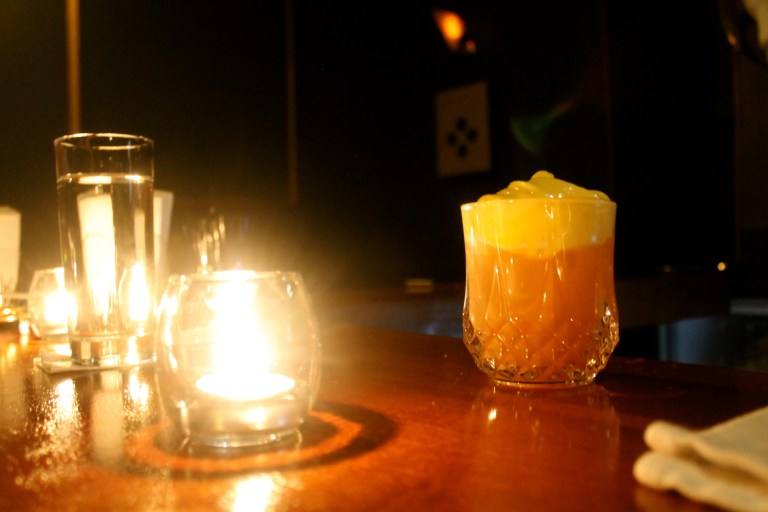 The location has changed! It’s now in the neighborhood of Quinta Camacho. Calle 69A, #10-05. No longer secreted behind the Pan Asian food restaurant, Thom Ngon, on top of Xarcuteria near Parque 93. Go up the stairs and ring on the doorbell. Someone will open the little window (just like in the prohibition movies) and let you in. Maybe. The owner says that he wants this place to stay secret and hidden so that only those who like a good hand crafted drink will hear about this place by word of mouth. He says that he doesn’t want the meat market “seen scene” (my description) types here. We shall see.
 Unlike the other
