Resources for Expats Living in Peru

nFl6V4I1gah5iRVNhBl635ZQgWjWPymn6ten2VCNCiQcUM3CdbeKxmMcXGLSGBcofa-C_DrNmj5c2TKT9y6PMIWtdXCaLvcQRSPpmtbGNop_dwqQO1yBqNnuGGQK3Is9exiLBlP_tJd53MyIc4n8A6Z-DzRGbze20oKE2P0U20rGkrdTScZoYUYtArNormally, I would have done lots of googling before moving to a new country but with Peru, I’m playing catchup. Here are some expat sites from a quick trawl on Google:

I’d say the most “famous” is Living in Peru started by a Dane, Carsten Koch: Living in Peru.

Live In Peru: for finding real estate in Peru. The hot spots are Miraflores, Barranco, and San Isidro, but I’d go for Magdalena La Mar and Lince, if I was looking.

Expat Peru

Internations

Transitions Abroad

Escape Artist

Expat Woman

Expat Focus

Expat Exchange

Life in Peru

Pink Pangea

American in Lima

Matador

Life in the 3rd World

No Sleep Till Peace

The blog of an expat.


For concerts: http://conciertosperu.com.pe/agenda-conciertos/ (including free ones  or “gratis” in Spanish)

And because food is one of the major delights of living in Peru (picarones shown below):  Peru Delights

DZgj2cJD-AEJpK1OHdIQprYAUapYoT0tvtKunBFM-vvFei660fRhoedVy1jNhXmgsr2Bnu-sSQNP2ziIUtV2Hn63WHfh9GLcNSZBOdbTavd79JLxyRJP2-7S33FOsBoiRIXYPXykgINiiluhsxjfoxi2rpxv7jEggBe-6AsRrA2Boh9E9XF0_ka5Vh

100 Restaurants in Lima (and Counting)

To make it more useful, I’ve made my blog posting about 100 Must Eat Restaurants in Lima easier to find on my blog. This post is now bookmarked to the front of the page.

1l0L20fmvHGrmW_dJ44Yfm7ZS_ssAhkPst0WOMcHJncJ6OUotia9fHsAXmpsy1sZ83j-_3dpwkosgR8XQdbCuG27oVSP-Ig-24pMbcwAtLutKHEog9ITc_w3wO6AJYw_4pLAS6yZhZkNnjvE5cCHqF_3uYSVB1T_gFLCjnq9JawmYXs6F5C3gfyo_r

In the Eye of the iPhone?

img_0073As much as I like the photos that I take with my “big” DSLR camera, I’ve stopped lugging it around. Sometimes convenience is more important than a big lens. With the improved camera on the iPhone, I tend to just snap my food photos before I eat, and avoid a fancy photo shoot. I imported a photo from my iPhone SE and did a little post-production on it. Yup, I think it looks fine for my purposes. That said, I still work on having the light (muted daylight is best) coming from one angle, and I only take close-up photos.

Usually every photo can look amazing on a computer screen — it all depends on the number of pixels on the screen. But, to print a photo, it has to be a certain size. These new iPhone SE photos are large so I think they will print without too much pixelation. I’ll find out later when I work on a new book…

Five Years of M’s Adventures

It’s M’s Adventures (madventures to many) fifth anniversary. This map shows just one random day of visitors to my blog…

screen-shot-2016-10-26-at-6-55-14-amAs seen on the map, the readership of my blog seems very dependent on subject. That subject is Bangladesh. Despite the fact that Bangladesh has a small landmass, it has a large population, and in the social media universe, an interesting statistic. If one looked solely at who is reading M’s Adventures and what topics they like, then it would seem that Bangladesh was the center of the world. But, I’m sure that Google could tell you that that Bangladesh is not the most searched term in their engine. I think that the spike in numbers on M’s Adventures is because there simply aren’t that many blogs written in English about Bangladesh.

As I watch my readership numbers dip, I wonder if I should stop writing this blog. Or when it’s just me and my friend’s cat reading the blog.

But, I’m still amazed each day to see how many hundreds have read my little blog. So for now, I keep blogging! After all, if I didn’t blog about it, did it happen?

100 Fruits in Colombia

12045302_10153648238159618_515981556999707268_oAs I mentioned, I planned to try 100 new (to me) fruits while in Colombia. Here they are.

Uchuva (cape gooseberry/yellow berry): These cherry-sized yellow fruit inside a paper cover (they look like small yellow tomatillos) have an aroma that I can’t describe (a subtle tomato-ish aroma), are slightly sour, and have a tomato-like texture. img_3630

Lulo: This fruit is unique to this part of the world (grows in Ecuador and Peru as well). The Colombians have really made it part of their daily juice selection (fresh juice is a part of daily life here). The lulo looks like a tomato but is super sour so only used for juice. The juice is greenish in color even though the fruit is orange. img_6600

Pitaya (yellow dragon fruit): This fruit could change the world. I call it the “110-minute fruit”… as in, you know where you will be 110 minutes after you’ve eaten it. I like to scoop out the insides sort of like eating a kiwi. It is part of the cactus family. img_6597

Maracuya (passion fruit): When I went on the fruit tour, I learned that the passion fruit sold in the U.S. is the brown version created by mixing a “mom” and a “dad” fruit. In the photo, the big round greenish one on the right is the “mom” and the long narrow one on the left is the “dad” (called a “caruba”) and the one in the center is the one I think of as a passion fruit.img_7999

Tree tomato: I tried three different kinds of tree tomato in Colombia. They don’t have much flavor and look like long narrow tomatoes. img_6599

Chirimoya (custard apple): This green pear shaped fruit that looks a bit like an artichoke is a surprise. 10421300_10153347353934618_6551906275350936819_n1

Kumquat: Looks like a grape-sized orange. Supposedly you can eat it, rind and all. I find it very bitter.

Papayuela. The only fruit that must be boiled with sugar before consumption.905967_10153648165584618_2113259764934613346_o1

Orange: The oranges used for Colombia are often green on the outside and orange on the inside. And sweet.10295299_10153154808029618_6497864187278336944_o10649655_10152941158444618_304262838288101202_n

Mandarin: I mention these because the juice is great. Most of the mandarins I tried in Colombia were in juice form. When I would go to my favorite market, Paloquemao, the vendors would often give me a free mandarin. I appreciate the freebie but really I don’t like the mandarins because they are too papery and fibrous. But, great as juice! And so incredibly orange colored (the green juice in the back is feijoa – mentioned later)!10295925_10153141348034618_1238038620572353122_o

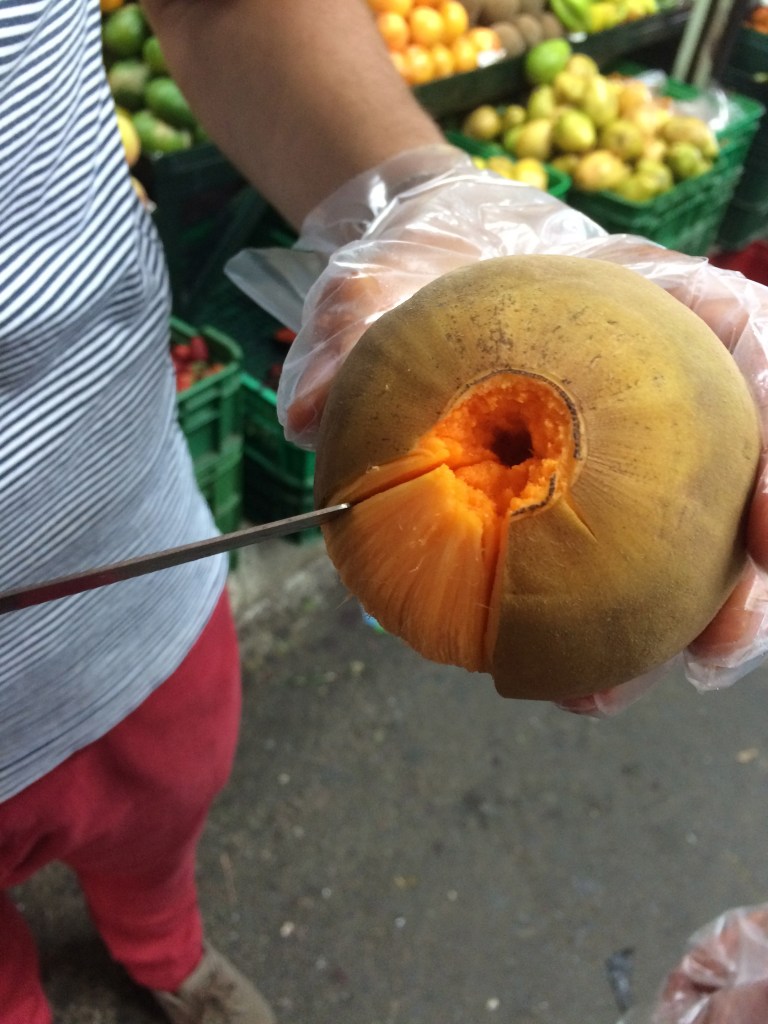
Zapote: Baseball size and dirt-colored. Inside is the texture of a pumpkin and it is bright orange. This is just one of the fruits you can try on the fruit tour in Bogota. img_7981
Obos: It looks like an olive and one chews around the hard seed inside. It seems like a lot of work for what you get.

Mamoncillo: Little round hard fruit a bit like lychee but without the same aroma.img_0606

Curuba zanahoria: The fruit from a palm tree. It’s a bit like a pumpkin. It needs salt, sugar, and lime juice… is it worth it?img_14371

Feijoa (pineapple guava/guavasteen): It tastes like kiwi with a soapy aroma. Not so good for those who don’t like cilantro. Used mostly for juice. Named for a Brazilian explorer.img_7994

Guayaba araca (wild acidic guava): These are yellowish and the size of an apple. The aroma of these led me to them in the produce section. Inside the flesh is pale custard color with flesh like a peach. But, they are super sour. Once I read about it, I found out that it needs to have sugar added and it needs to be diluted to 1 part juice to 10 parts water.

Granadilla: This was the go-to fruit for Colombian school kids because this is a sturdy fruit (and apparently the kids would smash it against their forehead to crack it open). 12109738_10153648238154618_4031459241144594892_o

Guamas: looks like a mega green bean pod but you just eat the inside white fluff that surrounds the beans.fullsizerender62

Carambola (starfruit): You have seen them on many a cocktail. I assume.

Papaya: This is a meat tenderizer and the Colombians eat this for breakfast — like they are trying to tenderize the night.

Pepino melon: a long attractive melon. photo53

Agraz (blackberries, but like a small bitter acai): This small berries are so bitter that they must be good for your health. 11223961_10153648176094618_8871581844640326146_o

Higos: The fruit of the cactus fruit. img_1512

Cashew fruit: The fruit of the cashew tree is great if you can get it. The nut hangs off the end of the fruit. It’s much better as a juice. img_1477

Mango: There are many sorts of mangoes. Colombia has the larger reddish kind.

Mangosteeno (mangosteen): Not from Colombia but they are very proud to grow them here. This is my favorite fruit.img_9791

Piñuela: This was a small shallot-shaped fruit. To eat it, one peels the leaves it like a banana. Inside is a white floss around a large black seed. Eat the floss. 11703215_10153432786054618_6224118621775175662_n

Yacon: I first heard of this in the U.S. as it was being used in dried form as a diet tea. It’s sold on the streets of Bogota. On the outside, this fruit looks like a dirty potato. On the inside, it looks like a pear. Sort of. 11428034_10153347356384618_6703100946318414907_n

Plantain: It is a fruit. It’s eaten like a starch. It is. But, it looks like a banana. A word about bananas in Colombia. Most of them are spotty. There are many different kinds. If you want unblemished Dole bananas, you need to buy “export” bananas. And good luck finding them. 10629567_10152764664629618_2203745753734451276_n

Breva: This fruit looked like a styrofoam. I had lots of discussions with my Colombian colleagues about what it’s actually called. I believe it has to be boiled with sugar for ten hours.11893871_10153648327319618_3449185676384618469_o

Noni: And then there were these “noni”… so ugly. Apparently, they also have to be boiled for 24 hours with sugar. I couldn’t find anyone who had ever had these.

12038856_10153648327109618_4873066923029458107_o

Actually, the rarest fruit to find in Colombia are lemons.

While researching the names of the fruits, I found this photo contest. It’s amazing to see what fruits are out there for us to try: Some links to other fruit adventurers: A blog about all kinds of things.

I did not find 100 new fruits to try, but these are a sample of the ones that I tried. Many of the new fruits were variations of other fruits. And frankly, a lot of the fruits were not very tasty and had to be boiled with sugar for 24 hours to be edible… stick with the pitaya, lulo juice, and mangosteeno.
 

Best Coffee (Shops and Cafes) an Bakeries

I can’t leave Bogota without mentioning coffee. Coffee shops are very popular here. Some of the famous brands of coffee are Juan Valdez, Oma, Amor Perfecto, and lesser know is Bourbon, but it gets confusing because some of the coffee shops use other brands but make the coffee so well that your experience will be changed! One of those places is in the Hilton on 7th Avenue. The barista certainly takes a long time to make your coffee (including asking you how you want it – percolated, drip, etc. etc.) and it is nice. But not good if you actually just need a cup of coffee. The cafe looks like a 1920s location so the decor is appealing as well. I like Bourbon, both for their coffee and their cafe. And the fact that they make coffee with almond milk, for those who care about that sort of thing.

13220685_10154160417399618_6869800116600708308_oBut, the best bakery is Arbol del Pan (Calle 66 Bis, #4-63: they are located up near Gordo and La Fama, on a street parallel to La Fama). Their coffee is okay but it’s their breads that are the best. Plus, they are open for breakfast. They make a poached egg, asparagus and prosciutto croissant that is delectable. This is not to say that I don’t still enjoy Eric Kaiser and Masa’s products. But, I think I like Arbol’s almond croissant best. On top of which, the staff speak English and the owner has one of those great back stories (architect decides to become baker… and it’s a woman-owned business, for those who care about that sort of thing!).

Four Years of M’s Adventures

I’ve been writing this blog for four years. In terms of subjects, my informal assessment is that the social media world is most interested in Bangladesh… Or rather, my blog is one of the few about expat life in Dhaka, Bangladesh. When I check the statistics, I’m amazed that my blog has more than 3,000 readers every month.

IMG_1050

Having this blog has changed the way I travel, sort of. Mostly, my friends are now quite accustomed to waiting to eat so that I can take a close up photo of their food. Thank you.


It Would Be Bizarre to Say No to Food

Two pieces of moose nose, one sans hair.

Once in a while, I find myself in a situation both familiar and exotic. I went to visit family up in Alaska, out in the bush, on the mighty Yukon, and found myself invited to a “potlatch” dinner. The village I visited is primarily inhabited by one tribe of native Americans and the food was truly Alaskan. I didn’t expect to ever be in a “Bizarre Foods” episode but I guess that’s what it was to my Facebook audience.

Fish ice cream.
Fish ice cream.

Sitting at the dinner, being served by the youths, it was a heartwarming study in respect. There was way more than enough food but only the elders got the choice pieces of seal blubber, moose nose, and jarred silvers (pickled “silver” salmon). Everyone got ham slices the size of lumber, pasta salads in infinite variety, fish chowder, moose stew, moose soup, spaghetti, jerky, pudding with marshmallows, slaw, goose, and more pasta salad. It was considered rude to refuse any food so every place setting was outfitted with ziplock bags so that everyone would have food for the taking.

I was raised to “try everything once” and to be polite… the moose nose was very sticky and chewy a bit like pig ear (if you know what that tastes like). The fish ice cream was interesting and I could see how that would be the best treat on a cold winter day as it provides fat, creamy tartness. I imagine that when cold, it’s even better. The three flavors I tried were cranberry, salmon berry (I guess from the pink color), and “black” berry which is a small pearl-like berry, smaller than a blueberry and not of much flavor. The cranberry was the best because of the tartness. The ice cream is only slightly sweet and I totally get why it’s called ice cream.

Now, don’t call me Andrew.

Burning Like Bacon on Machu Picchu

Huayna Picchu behind the Machu Picchu ruins.

“What is that pain? Do you smell bacon?” I thought to myself as I stood atop Machu Picchu, one of the wonders of the world. It was high noon and I was in short pants. With bare feet. Standing at the oculus of the Incan empire. Getting fried like a piece of bacon on a grease fire.

Inside the Vistadome.

Aside from the bacon sensation, I tried to focus on the spirituality of Machu Picchu. Without doubt, it’s beautiful. A bucket list place, done. Even in the harsh flattening light of mid-day and crawling with 2,000 tourists (or whatever the daily quota is these days), Machu Picchu is still awesome. Just like the bus ride up from Aguas Calientes was awesome. Even after endless ruins and crenellations razoring one valley after another, it was still impressive. Go there if you can. Maybe do the early morning tour.

The river way down below. Not great if you are afraid of heights.

So now I’ve seen it. The number one destination in South America. Yes, it was worth it. They even have an “accessible” (handicap) path for those in wheelchairs! I loved it. Me encanta!

Walking down.
Walking down.

It’s amazing to stand there on Machu Picchu, breathless from altitude and wonder. Imagine the sweat it took to build it.

Our guide, out in the mid-day sun.

And I’m whinging about a few painful sunburns.

They cleaned all the windows on the Vistadome train before we set off.

A Birthday Wish for Colombia

Today, on Colombia’s birthday (205 years old), I went for a walk to see how Colombians celebrate. I knew there was a parade somewhere and I’m pretty sure that I heard the flyover, but mostly, I noticed that almost all the buildings were flying the flag. I went out to a favorite eatery and as I pondered my cafe latte, I wished Colombia a happy birthday. Google had Colombia as a their design today, but in the headlines, it’s another country starting with a “C” that has grabbed the spotlight (also, I’ve noted that my blog readership had dropped now that I blog mostly about Colombia — which makes me realize the power of 170 million Bangladeshis, with smartphones!). Speaking of things starting with the letter “c,” my birthday wish for Colombia (other than people learn to spell her name correctly) is that she will loosen the fetters of her reputation for cocaine and kidnapping. Instead, I hope that people will think of Colombia when they enjoy their coffee, or nibble on organic chocolate, or cruise into Cartagena. Or come seeking the legend.

Coffee beans on the bush.

One year later, I thought I’d comment on my post about stereotypes about Colombia:

1. Aren’t you worried about getting kidnapped? (I wouldn’t go to Colombia if kidnapping was a guarantee. Duh!)

Answer: Still not worried. I stay in my bathtub, blubbering at my rubber ducky.

2. It’s dangerous. You will get mugged. Or worse. (Bogota, with seven million inhabitants, has all the usual dangers of a large city so I think my chances are equal those if I lived in New York or Bangkok).

Answer: Yes, it is. Hardworking Colombians get killed for the price of their cell phone. But, again, are you going to stay in your bathtub? No. I wander around during the day, going on epic 100-block walks. I don’t wander around at night. At night, I admire the reflection in my bathtub. 

3. Will you become a drug dealer? Or an emerald smuggler? (Why would you ask me that? Is it a conversation starter?)

Answer: Again, why would you DARE ask me if I really was one? And, frankly, I’d completely forgotten about the emeralds. I guess the Wizard will disown me now.

4. I hear that plastic surgery is really cheap and of high quality there. Are you going to get plastic surgery? (Thanks for the suggestion?).

Answer: Yes, it is. I’ve heard that a tummy tuck is about 4,000 dollars. Now, if you want danger, cheap plastic surgery is the way to go. But why would you scrimp when doing surgery?

5. Colombian women are the hottest in the world. You will get divorced there. (Colombia ranks first in bird bio-diversity…)

Answer: Some are. Some get plastic surgery (not the birds). The Colombians certainly seem to be careful about their appearance. Not all women wear high heels here in “cold” Bogota. But, the jeans are super-uber tight. Like shellac-tight (I just made up that term but you can imagine how tight a car is with its paintjob). The men do not wear tight jeans. No equality here. 

6. You will get married there. (If I go to a wedding, I’ll blog about it for sure!)

Answer: Not yet. It’s hard to meet anyone when cowering in my bathtub.

7. Oh, you’ll be having a lot of romantic assignations (Okay, they put it more crassly.)

Answer: See number six (and one) above. Plus, something about beeswax…

8. You will enjoy the steamy hot weather (Not in Bogota. The daily average temperature is 48-68 F, or 9-20 C)

Answer: Not hot in Bogota. Average is 65 F or 14 C. I love it.

9. Hope you like salsa because there will be lots of it. Any opportunity and Colombians start dancing! (Yup, bring on the vallenato, cumbia, hard salsa, salsa romantica, porro, and so on. More later.)

Answer: I do love salsa, both the dance and the dip. So far, the funniest salsa (or was it something else?) experience I’ve had was an awful experience at a club watching a drunk client get escorted back and forth from her chair to the bathroom. Otherwise, the most salsa I’ve done is the two-step on my slippery waxed floors. 

10. You will never want to leave. (The Colombian public relations slogan says, “the only danger is wanting to stay” so maybe they are right?)

Answer: I don’t have a bathtub.

Zooming In – I Love It!

Zooming in at maximum capacity.
Zooming in to capture color intensity.
The parrot with a standard lens.

I got a new lens. For the geeks, it’s a 75-300mm. All I know is that it allows me to zoom in from across the plaza. Right in tight on people’s faces. Or bird faces.

Close up portrait.
Close up portrait.

These photos were taken in Peru, in Iquitos, on the Amazon. All the subjects agreed to be photographed (the humans put on their tribal wear during the day to participate in the educational tours given to tourists).

A boy getting ready for the show.

People have fascinating faces and this zoom provides another tool for portraiture.The real personality shows up when the camera isn’t right in their faces.

A beautiful woman of the Amazon.

As I kept saying when taking these photos: “me encanta” or “I love it.”

Lima Food Tour Translated Into Spanish and Portuguese

Classic ceviche.
Classic ceviche.

My blog posting about my 48-hour food tour in Lima got picked up by a luxury travel site. They even translated my blog posting into Spanish and Portuguese. Thanks, Intiways! The fascinating part was reading my blog posting in Spanish. I learned new words (“dona”) and new terms (not “Japanese-Peruvian” but “nikkei” for the Japanese influence in Peru).

Here’s a sentence for Spanish speakers to enjoy:

El “ceviche asiático” con comida marina es tanto una mezcla visual como gustativa del ceviche peruano y el sashimi japonés o nikkei (de la comunidad peruano-japonesa).

I wonder if they will pick up my other blog postings…