The fries at Barks are the crispiest I’ve had in Adana.
I was trying to learn how to ask for my fries to be fried crispy and crunchy, and accidentally learned a slang word.
Citar (Che-ter): Crispy as in how I like my fries. Apparently also slang for a hot young thang. But for fries, I was told to ask for “citar citar olsun” and it worked.
Fries are a normal part of any “khavalti” — Turkish breakfast. To the left is menemen, a shakshouka-like egg dish.
I also learned that “mashallah” which is used joyfully as “god willing” is also slang for “fat.”
The first thing one has to get used to is the ‘c’ is a ‘j’ as in “Can” is “Jan” or “Jon” — or as in Jif. Then, there are those tails on some of the letters. That makes is an es sound.
The C sound make this product, “Jif”
Speaking of es sounds, the word for water is “su” but it’s a fast su and not “sooo” — that is broth or “suyu”… I think that’s what I was told. The soup in the photo below is a chicken soup, or “çorba” (say “shor-ba”) with spicy oil and lemon.
Rice and chicken soup with spicy oil.
Much of the food here involves lemon/lime so you can add a fresh zest to every bite. Another thing about the limes and lemons here is that they are a mix of the two but not as sour.
I always try to share some of the great things about living wherever I live. This is my list of great things about life in the Washington, DC, area. (I will write about some of the “realities” of life in DC).
The historical sites: There is so much history here that one can visit for free. Most of the museums are free. There is a lot of history here even if it is not as old as in Rome.
Georgetown and Old Town Alexandria: These two small towns are part of the bigger town but they are old (for America) and were some of the first towns built in this area. They both retain that old time feel.
The national parks: So many of the parks are free.
The nature: So much greenery and nature available. There are trees everywhere.
Free things: Like the concerts at the Kennedy Center. There are many free events and that is a nice thing.
Transportation: Most cities in the United States do not have good public transportation. Washington has a metro system that is a combination of the subway and buses. It works (although slowly at times). Also, with Uber, Lyft, and Empower, it’s easy to get around without your own car. With three airports serving this city, it is easy to get a flight. National Airport is on the subway system (metro) and it is quite close to the downtown. Dulles is on the metro as well.
The immigrants: This area has some decent Ethiopian, Korean, Salvadoran, and Vietnamese food thanks to the immigrants from these countries.
The Internet: Decent speed and steady (most of the time).
Delivery: One can get almost anything delivered to one’s door.
The electricity: Same thing. Steady. Most of the time.
The water: It’s potable and most of it tastes okay.
The language: English is spoken by almost everyone.
Lekker. If you mention that you are traveling to South Africa, people will tell you about lekker (which means “great” or “awesome”), but there are other fun phrases and words to learn in colloquial South African (Afrikaans is a separate language, but some of these words, like lekker, come from there). Here are some of the phrases I heard and asked about with South Africans. (Other than vocabulary, there were some funny signs. I’ve used some throughout this blog posting).
Boomslang is an elevated walkway.
Lekker: is “great” or “super” and is used frequently.
Braai: a barbecue, as in an event, a thing, etc.
Boma: a campfire meal gathering. Come from British Officers Mess Area.
Lanie: translates to fancy or posh (posh is pronounced “poache” like gauche)
I just liked this sign.
It is not a train smash: it’s not a big deal.
Pleasure: used like an affirmation as in “it was a pleasure” but they use the word by itself.
Shame: can be used both as negative and positive. Like “oh really?”
Hot chick’s. Notice the possessive.
Hectic: means bad.
Hish: also means it’s bad.
A banana general dealer.
Now now: means it’s not happening now. In a while but not as soon as “just now.”
Just now: means that it will get done but not right now.
Is Hardbody Mogodu the proprietor?
Yobo: an enthusiastic yes.
Exciting revamp ahead.
Robot: traffic light.
It’s a monkeys wedding: when the sun is out and it’s raining.
Do not feed the baboons.
It’s such jol: it was a great time.
I love symmetry.
Howzit: how is it.
Biscuit: roundabout or traffic circle.
Ladies mile.
Cap/MCC: sparkling wine (cap classic).
Pudo: a post office box or receiving box like an Amazon box.li
One of the cutest things I encountered in Italian class was a misunderstanding. Our teacher would say, “chiaro?” often. This went on for days until finally one of my classmates asked what does “chiaro” mean? She thought that it meant “honey” or some other term of affection and that our teacher was calling us this several times an hour! Our teacher was asking us if we understood what was being said! “Chiaro?” means “clear?” in Italian.
The title of this blog posting refers to a Danish movie from 2000, and my current activity. “Italian for Beginners” is a lighthearted entertaining movie about Danes who want something a bit more interesting in their lives so they go to Italian class. Romance and “viaggio” to Italy ensue.
Learning Italian is a bit topsy turvy for me as Italian is, in many ways, the opposite of English and Spanish. For example, the “che” is a “kah” sound and the “ci” is “cheh” sound as in “ciao.” The double ell in Spanish is spelled with a “gli” in Italian but the double ell like in “bello” is a really forceful ell sound. The ñ in Spanish is spelled “gn” in Italian so that “gnocchi” is “ñ-o-key” — and so on.
Actually, the phrase I’ve learned the best is “attenta su pronuncia” – watch your pronunciation.
But, it’s most important to say hello, goodbye, please, and thank you. So far I’ve learned that the Italians are very formal so one should not use “ciao” unless you are family or you are close friends. (Also, “Ciao” derives from an old Venetian saying for “I’m your slave.”)
Hello: “buongiorno” (bwon-jorno) until sundown and then it’s “buona sera” (bwon-ah sarah)
Goodbye: “arrivederci” (a-riv-eh-dare-chi)
Please: “per favore” (pear fa-vore-eh) or “per piacere” (pear pah-chair-ee)
Thank you: “grazie” (gra-ts-ee-ay)
Excuse me: “scusi” (skoo-zee) is the formal form and “scusa” is the informal.
One thing I have learned about Italian is how to say “good luck!” Contrary to direct translation, it is not “buona fortuna!” Instead, it’s “jump inot the mouth of the wolf!” Or “In bocca al lupo!” This is the equivalent to “break a leg” in Italian.
The addresses in Lima are kind of fun (well, one has to have some fun while in traffic!). Just take a moment and enjoy the name of the street in the photo. For a non-native Castilliano (Peruvian Spanish is “castillion”) speaker, this is a challenge… sip-ee-own-yown-a?
Jiron (jr.) is a small street. Sort of like a junior street.
Calle (ca.) is a street.
Callejon is an alley.
Avenida (av.) is an avenue and normally a long street.
Pasaje: is a cul-de-sac.
Paseo: is a street for a walk like a boardwalk. Streets like Arequipa that are divided with a sidewalk and trees in the middle are meant for these “walks”.
Prolongacion (prol.) is a an extension of a street.
Cuadra (or cdra) is a block.
Ovalo is a traffic circle/roundabout.
Sin numero (s/n) means that the house has no number.
Solar: is an alleyway in a fancy neighborhood.
Alta means that it’s at the top of the street or block.
Manzana means an apple but in this context it means a block. The term most likely originates from the feudal system (and not as I hoped that it was the amount of space that an apple tree spreads its roots). The use of “manzana” and “lote” or lot is predominant in some of the “conos” or northern, southern, and eastern districts of Lima. These are mainly lower socio-economic areas.
And related to this, an apartment is a “departamento” or “depa” and the first floor is the ground floor here.
I recently cleaned out my closet and donated eleven large sacks of clothes and shoes to an NGO that assists Venezuelans in Peru, Union for Venezuelans in Peru. If you want to donate, call the executive director, Martha, 992-824-991, and she will meet you at the Union for Venezuelans in Peru at Avenida Benavides 3082, which is actually located on the Ovalo Higuereta, in Surco. The building is not marked as the Union has not spent money on signage (the employees wore white work shirts with the name of the organization on them). The office is on the third floor but it was not open yet when I made my delivery. The Union for Venezuelans in Peru will also pick up.
When I chatted with Martha, she explained that the refugees are in need of everything as they arrive only with what they can carry in their hands. She said that many are young families. She told us about a family that were happy as they picked up an inflatable mattress. Makes one think.
In the last few years, nearly a million Venezuelan refugees have arrived in Peru. Thirty years ago, Peruvians were fleeing to Venezuela and not the situation is reverse. Peru is currently in the honeymoon phase of this reverse situation and the Peruvians are welcoming the Venezuelans with resident permits and work permits. Many work as taxi drivers, in restaurants, and some sell candy to make a bit of income (I know one shop owner who gives the candy for free the first time around so that the refugee can build a bit of capital — like the Grameen system — although this shop owner will probably not get a Nobel prize. He does it for the humanity of the situation). I have seen Peruvians buy these candies out of an act of charity, much in the vein of “there but for the grace of God, go I.”
In many of the shops and restaurants, the workers are Venezuelans. They have the advantage that they speak the local language. When I was in Port of Spain, many of the workers were Venezuelans (Trinidad is only a few miles off the coast of Venezuela). This proximity means that many Trinis speak Spanish as well. I actually understood the Spanish better than the Trini form of English when in Trinidad.
Here in Lima, due to the influx of Venezuelans, there are more and more Venezuelan eateries. When I lived in Caracas, I developed a taste for arepas and now I can find good ones here as well. I did not get some after the trip to donate clothes. I had enough food for thought.
Some Peruvian dishes have funny names, and all the dishes have a story. It’s useful to know what is what. Many of the dishes originated in the working class and I have been doing my own experiment to see if it’s true (more on the class system later).
Suspiro limeño = sigh of a person from Lima: the classic pudding dessert from Lima
Causa = cause: a layered cold potato dish whose origin is supposed from the women helping their men with fighting for the cause in the 19th century.
Leche de tigre = tiger’s milk: the lime marinade used for ceviche. Chicharrón… de pescado = pork crackling… of fish (in the photo, the leche de tigre has chicharrón of fish on it): this is the terminology used for deep fried fish or chicken, etc. Much like “chicken fried” in the U.S. Chicharrón is also used to indicate the substantial pork roast cuts that include the crackling. Also the name of the sandwich (often served for breakfast) with the same pork roast slice.
Jamón de pavo = turkey ham: turkey deli meat that is processed to taste like ham.
Malarabe = bad arab: a soup from the north of Peru. King Kong: a King Kong sized alfajor sweet. Revolución caliente = hot revolution: a pastry sold at night, with its own song. Steeped in history.
Champú = shampoo: a dessert
Aeropuerto = airport: a stir fry dish so named because a lot of items land on the plate, mainly noodles and rice. This dish was named in the 1990s.
Siete colores = seven colors: a dish of seven colors, made with the following dishes — cebiche, tallarines rojos (pasta in red sauce), cau cau (made with tripe), papa a la huancaína (potatoes with yellow sauce), chanfainita (a dish often made with lung), arroz con pollo y ocopa (a peanut based sauce). Mostro (but a variant of the correct spelling of monster. I was excited to see the dish on a menu — proof that the dish actually exists) = monster (pollo a la brasa y arroz chaufa): a spit roasted chicken quarter on a mountain of fried rice.
Mostrito = a small monster: an eighth of a roast chicken on fried rice. I was disappointed that a small monster wasn’t a larger whole chicken, but that’s me with my sense of humor…
The last two dishes are most recent and many people have not heard of them and when I ask where one can find them, I’m told “in the outskirts” which is the euphemism for the “hood.”
The Spanish is slightly different here in Peru. First of all, it’s not Spanish. It’s “castellano” which is a result, I’m guessing, from when the conquistadors came over from Castille. The Peruvians use an incredible amount of slang, but I’m not sure if it’s more than everyone else. Now that I have dreams in Spanish (many of which “no entiendo”), some Lima specific terms are becoming part of my daily language. Here are a few of them:
de frente: in Spanish class, we learned “derecha” for “right” and “de recho” for “straight on” — that won’t work here. If you say “de recho” to a taxi driver here, they will assume you said to turn right and got the vowel wrong. If you want them to go straight, say “de frente”. Not to be confused with “en frente” which is across”.
A doubler – to turn.
Playa: parking lot (yes! so you will find “parking beaches” far away from the water).
Cobrer – to cost/pay.
Palta: avocado
Maracuya: it’s passionfruit but I have to recall the English because that heady scent seems much more of a “mah-ra-coo-yay” for some reason.
Ficho: fancy
Guinasso: F&*(*ing awesome. I think that’s how it’s spelled…
Hallar: hitch a ride
Sencilla (Efectivo/Plata/dinero in other forms of Spanish): for petty cash or small change. There is a lot of fake money here so people prefer coins and small bills.
Barrio versus district: seems to be a matter of “class” — when I referred to Miraflores as my barrio, I was met by giggles of embarrassment. It’s apparently not a barrio, and certainly not in Castillian!
This post is not about the best of Trini speak. I haven’t heard enough yet to know what the best phrases might be. What I do know is that I don’t understand the English here in Port of Spain. I’d say that my comprehension is on par with my Spanish comprehension… well, they might be neck in neck. (I almost felt relief when talking to a guy in Spanish! If three sentences counts as talking.)
The Trinis tell me that it’s because they speak fast. No, they don’t. They use different vocabulary, different grammar, different spelling, and they have a different cadence. In other words, a different language. They remove “then” and other prepositions (is that what they are called?). Or how about “the best food in tongue” which must mean “best tasting” or not?
Other than terminology like “lime” and “whine” there are many other words in daily life that are used which I can’t recall right now. I wish I could. One phrase that I wrote down was, “A good bit of us” for “there are a lot of us.” Sounds like British but without the accent.
The food vocabulary is easy to learn (bodi is long green beans) as that’s a matter of memorization, and many of the words have an origin that is typical of Trinidad’s cultural influences. Bodi probably originates from the Hindi word and was likely introduced by the South Asians.
And then there’s the spelling. See that “best” is now a woman’s name, “bess.” And “ah” for “of” as can be seen in the soup sign.
Linguists could have a field day.
Ya dam right gee. For de bess ah tongue.
Or something like that. I have no idea! Habla espanol?


 I recently cleaned out my closet and donated eleven large sacks of clothes and shoes to an NGO that assists Venezuelans in Peru, Union for Venezuelans in Peru. If you want to donate, call the executive director, Martha, 992-824-991, and she will meet you at the Union for Venezuelans in Peru at Avenida Benavides 3082, which is actually located on the Ovalo Higuereta, in Surco. The building is not marked as the Union has not spent money on signage (the employees wore white work shirts with the name of the organization on them). The office is on the third floor but it was not open yet when I made my delivery. The Union for Venezuelans in Peru will also pick up.
 In many of the shops and restaurants, the workers are Venezuelans. They have the advantage that they speak the local language. When I was in Port of Spain, many of the workers were Venezuelans (Trinidad is only a few miles off the coast of Venezuela). This proximity means that many Trinis speak Spanish as well. I actually understood the Spanish better than the
  Chicharrón… de pescado = pork crackling… of fish (in the photo, the leche de tigre has chicharrón of fish on it): this is the terminology used for deep fried fish or chicken, etc. Much like “chicken fried” in the U.S. Chicharrón is also used to indicate the substantial pork roast cuts that include the crackling. Also the name of the sandwich (often served for breakfast) with the same pork roast slice.
 King Kong: a King Kong sized alfajor sweet.
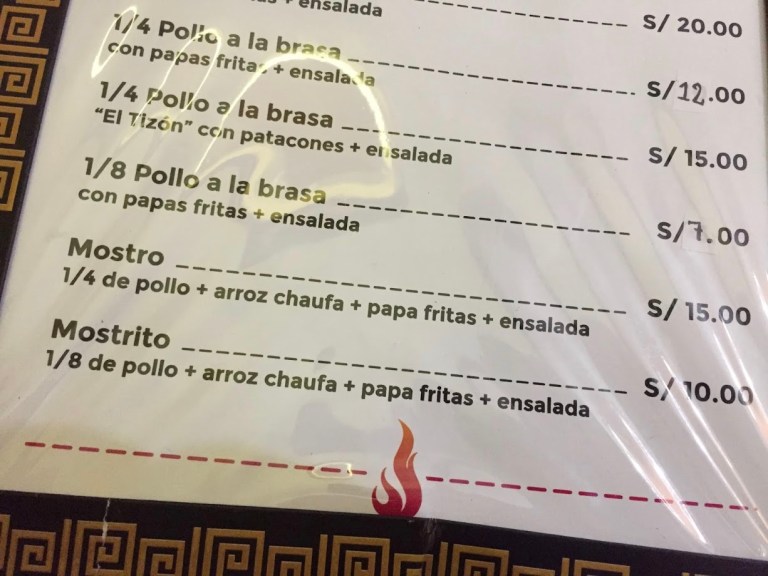 Mostro (but a variant of the correct spelling of monster. I was excited to see the dish on a menu — proof that the dish actually exists) = monster (pollo a la brasa y arroz chaufa): a spit roasted chicken quarter on a mountain of fried rice.
 Palta: avocado
 This post is not about the best of Trini speak. I haven’t heard enough yet to know what the best phrases might be. What I do know is that I don’t understand the English here in Port of Spain. I’d say that my comprehension is on par with my Spanish comprehension… well, they might be neck in neck. (I almost felt relief when talking to a guy in Spanish! If three sentences counts as talking.)
 The Trinis tell me that it’s because they speak fast. No, they don’t. They use different vocabulary, different grammar, different spelling, and they have a different cadence. In other words, a different language. They remove “then” and other prepositions (is that what they are called?). Or how about “the best food in tongue” which must mean “best tasting” or not?
 Other than terminology like
  And then there’s the spelling. See that “best” is now a woman’s name, “bess.” And “ah” for “of” as can be seen in the soup sign.