Do you love the Southwest of the USA? But wish it was in South Africa? Then you are in luck! Here are some of the things to do in Clarens, South Africa. The Golden Gate National Park is right there, and this town is near Lesotho, so it makes for a good stopping point. The area has a frontier, southwest USA, feel to it. It’s about fours from Pretoria.
Golden Gate Park.
Cheese tasting at Baris: This farm cheese shop is so fun. Go for lunch and order a cheese tasting.
Cheese tasting platter at Baris.
Hiking: This is the real reason many people visit this area.
Gorgeous sunset in Golden Gate Park.
Gin tasting: At Clarens Brewery, they have a gin store, Junipers Craft Gin Bar, and they do tastings (plus they have some yummy food including their ‘chips’ or fries and they have Bunny Chow, a curry-in-a-loaf-of-bread specialty of South Africa.
View over my Bunny Chow.
Shopping: Lots of artwork, souvenirs, cards, clothes, and gin. I almost bought paintings by this local artist, Johan Smith. There are other cute shops including the Purple Onion. Make sure to check them all out. They are all next to each other. Everything from art, fudge, cards, shoes, clothes, and antiques.
Clarens has a Southwest wild west feel.
Entertainment: This town has live entertainment including a local guy who is famous in this local town.
Old timey feel at Purple Onion.
Eating: Surprisingly good restaurants for such a small town. The Italian one, Bocca di Lupo, run by a guy from Bologna, is divine. Excellent pizza and pasta.
Spicy spaghetti.
Sleeping: You can stay in a castle. I stayed at the Protea, a Marriott hotel because it was about four minutes downhill by food from the Clarens square with the shops and restaurants. Made for an easy commute after shopping or eating.
The shop at Highland Brew.
Outside of the town of Clarens, there are other things to do and see. Other than the cheese place, there is also a dinosaur center. If you want another cafe with views of the mountains and hiking areas, check out Highland Brew. It has food and drink, plus a shop selling jam and coffee.
When baby elephants galumph, that’s when they are cutest.
I’ll admit that I wasn’t all that excited about going on another safari (okay, do I sound jaded?) but then, my friend reminded me that it was springtime in South Africa… and there would be lots of baby animals. And who, who (not I), can resist the cuteness of baby animals (I’m jaded but not a monster!)?
Going on safari entails not just the bit where you see the animals but also the “hotel” bit of the stay. The part where you see the animals is called the “game drive” because you drive out to see game. Most safari places have two game drives per day, one for sunrise and one for sunset. Depending on the place, you may have to get up at 4 in the morning. Others it’s 5 am. Our driver/guide told us that he would call us at 5 am and he wasn’t kidding. Every day for four days. We went on a four day safari so we went on eight game drives. There are also walking tours to see the animals. We did not do that, but you can if you want to. Each game drive lasts for three to four hours. Usually with a “pit stop” for a breakfast snack or a sunset cocktail snack. We were back at the safari lodge by 8:30 am every day, just in time for breakfast. Then again from 4 pm to 7 pm, back in time for dinner. After a lunch and a “tea” — going on safari is like a land cruise. You eat all the time!
Looks serious. I think it was an eland.
One’s safari experience depends heavily on where you have the experience. When I mentioned that I was going on safari, friends said, “oh, like glamping” — no, absolutely not. There is no tent involved. At least not for me. Some people like the idea of sleeping in a tent. Out in the bush where the warthogs and hippos roam…
I could even see the elephants from my bed!
I prefer to be separated from the animals when I am sleeping. We stayed at Madikwe Hills in the Madikwe Nature Reserve. Our place was fancy. The rooms are separate houses and ours was the size of an apartment. We had a sitting room, fireplace, large bathroom area with bathtub, shower, separate toilet room, and an outdoor shower. Outside, we had a wrap around balcony/deck and a private dipping pool. Our pool and deck had resident “rock wallies” which are a type of native rodent, like a guinea pig but slightly bigger. They moved away when we went outside and were not aggressive. Below is a slide deck of lots of the animals.
I liked the game drives at Madikwe. The guides from all the lodges are connected via radio and they make sure that no more than three vehicles are at any animal siting. This keeps it from being a circus. Often, it was just us and the animals. Our tracker sat on a chair on the front grill of the safari jeep (a nine seater + driver and tracker) and spotted animals and animal tracks for us. The driver/guide knows how to use a rifle and takes that with them when they go on walks (a “bush walk”). It takes a different sort of license. The truck is kitted out with blankets (they do safaris all year round) and the crew take well care of the guests (it is just like a cruise). They even fried up a “venison” meat every night, although the game venison was always sourced from a food source and not from the reserve.
What does it cost? Well, that depends on how lux you want. Madikwe Hills cost around $900 per night but we used one of their last minute deals that was 55 percent off. There is also the cost of tips, game drives, park fees, and park conservation fees. Don’t visit Madikwe if you are trying to do this on the cheap. Madikwe Hills is one of the most luxurious of the safari lodges. I chatted with some South Africans who were at the lodge and they mentioned this.
The gatehouse at our lodge with our vehicle waiting for us.
Most people go on safari in Kruger National Park. It is a bit more exclusive at Madikwe and the crowds are smaller. One night there was a cultural performance by the staff and a buffet “boma” which is a dinner around a campfire. The word, “BOMA,” comes from “British Officers Mess Area” and that factoid was my favorite part of it. Okay, not really, but I am a bit of a word nerd.
Looking into the interior dining area.
As for clothes, one reads about not wearing blue clothes or anything too bright. In Madikwe, that was not necessary. I had brought lots of lightweight long pants made of linen but in the end wore shorts and a linen shirt. It was hot. Like an oven hot. And in the early morning when it was cold, they provided blankets which were two layered with a fleece side and a windproof side.
Our tracker found a lost GoPro.
The animals in Madikwe do not include hippos or large elephants (in Kenya the elephants are much bigger than the ones down here) as those are not native to this part of South Africa. The lingo around safaris is different — there is the “big five” (African lions, leopards, rhinoceros, elephants, and Cape buffalo) which refer to the types of animals that you hope to see to check off your bucket list. We did not see a leopard.
Happy Hour on the game drive. Biltong, or dried meat, on the left.
I had never heard of the “little five” (Elephant Shrew, Ant Lion, Rhinoceros Beetle, Buffalo Weaver and Leopard Tortoise) which are related in name to the “big five.” The big five originally was a phrase used for big game hunting, but now the hunting involves camera shots only. Also mentioned was the “ugly five” but beauty is in the eye of the beholder so we had fun debating that list (warthog, vulture, wildebeest, Marabou Stork, and hyena).
This is the view you will have most of the time. Unless you have a zoom lens.
In Madikwe, the baby animals are allowed to spend their first six months not being watched by tourists which may make for less cute photos but is better for the animals. We did get to see cheetah “teens” who had just turned six months old so we were allowed to look at them. There are also a lot of birds. Lots. If you are a birder, then this is a joy. Take a huge camera lens. Otherwise, you will see the birds, but may not have photographic proof. The lodge gave us a little booklets so we could mark off what animals we had seen, including birds.
Zebra crossing…
Even if sitting in a dusty hot open air jeep is not your idea of a good time, you kind of get into it. I did. It was fun to learn about animal droppings. And to learn that lions pretty much just sleep all day.
One of the vehicles.
Was it dangerous? No and yes. No, because the animals are accustomed to the vehicles. So far, no tourist has been harmed (in 2018, a lion mauled a woman to death) recently. Yes, dangerous, because the vehicles have no windows. The animals are wild. We were told not to lift our butts off the seats because if the animals see a different profile in the normal “jeep” shape that they are accustomed to… as our guide said when one of our group started rising up to get a better photo… “that lion can get here in three seconds” — got it!
Let’s just say that we looked out for each other (as in we all yanked him back down onto his butt!). Because none of us wanted a lion attack. If you do get attacked by a lion, the advice is to face the lion and look as big as possible. The key is to not act like a source of food so no running like a gazelle. And, try to find well-fed lions.
Italy is famous for its agroturismo, a bed and breakfast on a farm. To qualify as an agroturismo, the farm must actually be a working farm. Many of these places will also have animals. Many are family owned. You can search this site or use other sites, like Google, to find a stay. Some of these farms have a minimum stay and during the peak summer season that may a minimum of a week. Because these farms are actually farms, often someone’s family homestead, the guest accommodations may not as fancy (or air conditioned) as at a hotel.
Wow, Sotto i Sassi, wow.
The concept of an agroturismo was started as a government scheme over 30 years ago, as a way to help the economy and tourism, which is 13 percent of Italy’s GDP. During the pandemic, I have been told, that the quality of the cleanliness has gone up at these farm stays.
Recently, I stayed at two that contrast quite a bit but seem typical of what’s out there.
One of the bedrooms in the apartment “room” that we had.
Sotto i Sassi: Located at Via Castellino 171, Guiglia. Near Modena. You can book them through the usual places like booking, airbnb, tripadvisor, etc. but my tip to you is to whatsapp him (Matteo Bizzini): +39 337 331 802. He speaks English.
The family farm is located up some narrow lanes in the countryside and you may get lost getting there. Use a GPS. And go left around the parking lot with the bench at the end of the road — the road continues to the left but, BUT, do not go up in the field. Not yet. Prepare time to find the place.
Once you get there, Matteo will greet you and help you to your room. The rooms are decorated stylishly like something out of a style magazine. There may be steps. During the pandemic, the breakfast part is a basket placed outside your room in the early morning. The onsite restaurant is not open every night but it’s an excellent restaurant with lots of outdoor (under the trees and stars) dining. The food is so good that it’s a place that people eat here for the food, even if they are not staying at the B&B. Convenient for not having to drive home after dinner, as well. Matteo takes a genuine interest in your stay with him. At dinner, he gave us a taste of his family’s balsamic.
Outdoor dining at Sotto i Sassi.
The grounds are free for walking around and there are some majestic gobstopping views. The air is clean and as it’s the countryside, you can hear the animals in the early morning. Sotto i Sassi is the kind of place that I imagined an agroturismo geared for slightly luxury customers. Lots of photogenic locations, nice bathrooms, kitchens, good food, not so fancy that one can’t figure out how to turn on the light (actually there were a lot of lighting options), but nice enough that you felt that you were staying at a deluxe farm. Some antiques and some modern design. Plus, the personal connection to Matteo, always just one whatsapp message away.
Some of the buildings are Sotto i Sassi.
Then there is the other sort of experience… The sort of experience where you feel like the hosts were gulag forced into exploiting their inheritance to keep it in their family. A place where the hosts are shackled by their amazing farmstead but can’t enjoy it because they are constantly changing sheets in the rooms. Corte Olfino was such a place. Their website makes it look cosy (I have not posted any photos here of this place — it was cute in a tired sort of way — be a bit suspicious of the website photos) and emailing with them makes it seem like they speak English. The couple who run the place look so unhappy. Well, she does. He seems oblivious to how miserable his wife is. She is harassed and stressed looking all the time. If this beautiful farm is her inheritance, I almost feel sorry for her that she can’t enjoy it.
The majority of the customers are German and they give the place a high rating. The place is interesting looking, like a small village, and the rooms are clean. But, the checkin process and accessing WIFI was difficult. I only found the WIFI code because someone left if on a scrap of paper on the table in my room. Some of the rooms are up in a tower from a fairytale and have a dungeon-like lock that makes it quite annoying when tired (mine had a modern key). The breakfast was fine and included the usual cake (yes, the Italians seem to think that tourists eat cake for breakfast), and toast, ham, eggs, and cheese (Is it this that makes them have higher ratings? The hard boiled eggs? The ham? Apparently it’s the price point and the cleanliness). Yes, they have animals including a llama, and maybe this is why people like this place. The prices were around 68 euro per room per night. So not so high. But, the overall prison feel given off by the house-poor owner made us uncomfortable. Also, the rooms had no sound insulation so one could hear everything going on in the neighboring room.
We felt no need to stay and left early. They owners did not seem surprised and did not want to know why (I paid for the whole stay even though we left early, but I wish they cared why we left early). I guess they don’t need my business. I wish them well and hope that they enjoy their farm when the cash cows are not there…
The doors at Sotti i Sassi are a photo-op waiting for you.
A word about air conditioning. A place like Sotti i Sassi doesn’t have it but even during the heatwave of the summer, the rooms cooled down by evening. Corte Olfino had AC but we also didn’t need it.
The season is over so you have six months or so to research where to stay next year.
I have spent more than 300 nights in hotels in the past few years, and this experience has made me appreciate the joys of having a fixed home. Here are some of the experiences that I had while staying in hotels and being “on the road” for months at a time. It’s not all bad, and, it’s not all good. Even at the most expensive and fancy places.
Toe nails: There is nothing so sharp and hard as a toenail shaving. And they don’t shine like diamonds.
Beads: I have stepped on more random beads (is it Mardi Gras everywhere?) than I care to count. I suppose it’s the nature of them being round, usually small, and many.
Shampoo: All those little bottles. It gets tiresome.
Laundry: Some hotels charge $24 per shirt. There seems to be not consideration for those who stay in a hotel for more than a week, and do not have 30 changes of clothing with them. Traveling makes one miss doing laundry.
Take out: I’ve had lots of it. It can get tiresome not being able to cook for oneself.
Bored of the food: Related to the point above.
Microwave or stove: you miss a way to heat up food.
Tiny fridge: not the name of a band. Also, why? Why oh why are these tiny fridges so low to the floor?
Cameras: yup. They are everywhere.
No privacy: Living in a hotel, one is never really alone as there are constant knocks on the door.
No that you have done Machu Picchu, you want to do the next big thing… Kuelap, the Gocta Waterfall, and so on. Then, the question is where to stay. The secret, secret, place to stay in Gocta… no, not that one… is… Gocta Natura. But only if you like “natural” and bohemian (and no WIFI). This small organization will give you ALL the FEELS. Warm, fuzzy, friendly. Gocta Natura has five cabins in the woods overlooking the waterfall. The price is per person and they employ a gourmet chef. Like I said, ALL. THE. FEELS. You’re gonna love it. If you like rustic, eco-friendly. If not, stay at the famous Gocta Lodge hotel located up the hill behind Gocta Natura. (Note: I have not stayed at either of the Goctas. This is just based on the rave reviews of someone I know who is “in the know”.). To see the waterfall up close, you can ride a horse for part of the hike, as it may be hot and sweaty. Then, once you have seen “the nature,” you get to go back to your peaceful cabin and enjoy gourmet cuisine.
The closest village to Gocta Waterfall is Cocachimba. It’s got a village green and the village doesn’t seem to consist of more than the buildings surrounding the green. The Gocta Lodge is at the end of the village behind a high wall. To get to the Gocta Natura, you have to walk the path on the way to the waterfall. Cocachimba’s altitude is 4,000 feet above sea level, making this village a better place to sleep if you suffer from altitude sickness. Chachapoyas is at 7,600 feet (2,300 meters) and Kuelap is 10,000 (3,000 meters).
I liked the drive up to the village of Cocachimba. Amazing views and amazing coffee. All along the road, locals were drying their coffee beans on tarps spread out in front of their houses. At one of the village restaurants, I had a delicious mug of coffee. When I asked what brand they had used, they explained that it was their own coffee, from their own beans, from their own tree. They weren’t showing off.
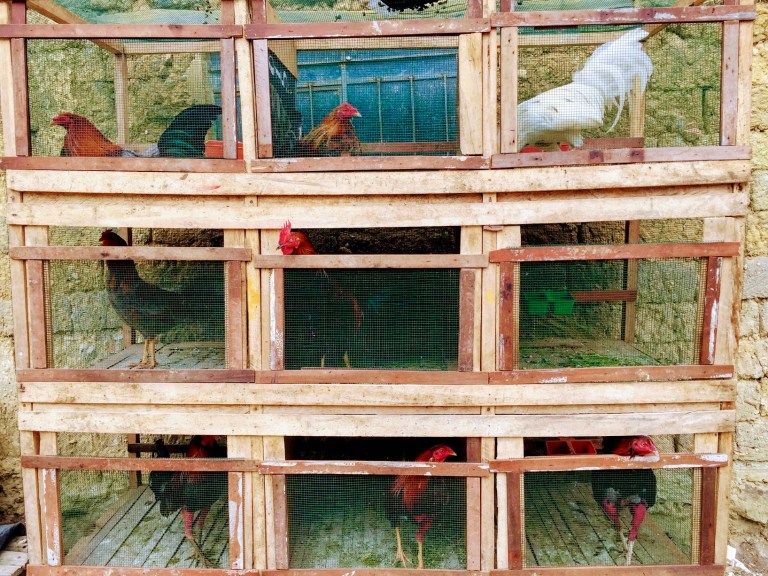
The photo of the fighting cocks was taken at a spot along the road to Cocachimba that had a spectacular view of Gocta waterfall. When I saw the location of the cages, I wondered why the owner of that house didn’t open a B&B in that location. I would think that tourists are a better source of income… and with fewer feathers?
A treasure trove packed into a riddle. Villa Ideas (formerly Ideas Manzil) is a guesthouse (ranked high on TripAdvisor) but it’s also a shop and a restaurant. They have set menus and the food is freshly made. It’s good. We went for lunch and to shop, and the staff at Ideas Manzil had decorated the table with flowers, textiles, and silver salvers. There is a wood carpenter, a leather worker, and a weaver on staff. The range of what one can have made seems endless: leather bottle holders, leather coasters, wood doors, carved fabric hangers… plus all the stuff to buy: boxes, brass, jewelry, Bhutanese textiles, Nepalese rugs, Bangladeshi folk art, lamps, vases, carved wooden walls and spandrels on carved columns (family crest carved into the wood — why not?)…
One of the guest suites.
One must make an appointment to shop here. The proprietor says that he will open a retail corner but… can it remain interesting? Finally, will this place last? Will it remain interesting once my friends have bought all the treasures collected over a lifetime?
Also, does a fabulous job on meals which must be ordered in advance.


 Bored of the food: Related to the point above.
 No that you have done Machu Picchu, you want to do the next big thing…
  The closest village to Gocta Waterfall is Cocachimba. It’s got a village green and the village doesn’t seem to consist of more than the buildings surrounding the green. The Gocta Lodge is at the end of the village behind a high wall. To get to the Gocta Natura, you have to walk the path on the way to the waterfall. Cocachimba’s altitude is 4,000 feet above sea level, making this village a better place to sleep if you suffer from altitude sickness. Chachapoyas is at 7,600 feet (2,300 meters) and Kuelap is 10,000 (3,000 meters).
 I liked the drive up to the village of Cocachimba. Amazing views and amazing coffee. All along the road, locals were drying their coffee beans on tarps spread out in front of their houses. At one of the village restaurants, I had a delicious mug of coffee. When I asked what brand they had used, they explained that it was their own coffee, from their own beans, from their own tree. They weren’t showing off.


