Every meal will end in tea, or “çay” (chai). It might even start with tea, if it’s breakfast, but it will always end with tea. Turkiye is the highest consumer of tea. It is customary to offer tea — always.
You can try to say no, but you will still get it. It’s like water in the United States. I have already grown accustomed to it. I still can’t hold the cup which is HOT. But, I do like the tea. I take it with one cube of sugar.
Tea is a serious shopping item.As is sugar…
There is an art to tea. I’ll write more about that later as I learn more. But what I have learned is not to drink it straight up. Dilute with the hot water which is always part of the tea setup. I didn’t know this and was drinking tea that was darker than American coffee…
No, not true. Well, yes, it’s that hot, but not all sherbet/sorbet is iced. Sometimes it is a drink. The original word derives from the Arabic term “to drink” (shariba) and in modern Turkiye, you can still find it as a drink.
Sherbet of rosehip? With Turkish coffee and cookies.
Sherbet can be had in many flavors deriving from herbs, fruits, and other plants. Some specific flavors are famous in certain locations, such as Bursa’s peach flavor (Bursa is the old capital of Ottoman Empire) or ingredients such as musk.
I had the one in the photo at the Women’s Cooperative in Adana. We didn’t ask for it. It was offered with the coffee. I think of the sherbet drink as being similar to Ribena in Germany or fruit punch in the USA. It’s a version of electrolytes.
Americans, gringos, are obsessed with Tex-Mex food and celebrating anything with margaritas, chips, and salsa. May 5 is a day that gringos have taken to heart as a reason to eat Tex-Mex food and drink Corona beer and margaritas (first invented in the 1940s). But what was Cinco de Mayo? Is it Mexico’s national day? No, that is on September 16.
Some bar… I can’t even recall. I think I was with my tia…
Cinco de Mayo, also known as Battle of Puebla Day, is a holiday that commemorates the Mexican army’s 1862 victory over France at the Battle of Puebla during the Franco-Mexican War. The battle lasted one day but the Mexicans won so May 5 is a local holiday. The French went on to win the war but their occupation of Mexico was brief.
In the United States, Cinco de Mayo is an change to celebrate Mexican culture. Depending on which source you believe, the celebrations began in 1863 in Columbia, California by Mexican gold miners celebrating Mexican resistance. Other sources say that in the 1960s, hispanic activists began looking for a way to honor their history and culture. What is clear is that in the 1980s, beer companies started using the day as a sales campaign. In 2013, beer sales ($600 million) for Cinco de Mayo outdid those for the Superbowl. The biggest Cinco de Mayo celebrations are held in cities with large Hispanic populations, such as Los Angeles, Houston, Chicago, and New York.
In 2005, the US government issued a resolution (a resolution is not quite a law but is official) to make May 5 a day to officially observe the celebration of Mexican/hispanic culture.
This was from a Mexican place in Poland.
Today, almost every bar and restaurant uses Cinco de Mayo as a commercial opportunity, and do not really care about the actual reason behind the day. And when the day falls on Tuesday… for Taco Tuesday… watch out. Or take Wednesday off.
The main plaza in Mexico City.
But now you know. Also, as an aside, Mexico City did not have a Day of the Dead parade until after the James Bond movie, Spectre from 2015. Since 2016, Mexico City has celebrated the Day of the Dead with a massive parade, tacos, margaritas, and beer.
Cacao juice tastes like nectar. Indeed, the Latin name for cacao is “theobroma” or “food of the gods”. To learn more, you can read the wikipedia entry of this blog. In Peru, this juice is called “mucilage” which is the technical term for the white pulp that surrounds the beans inside the cacao pods.
I first tried this juice at Kjolle (co-located with Central), Pia Leon’s restaurant. It was a hot summer day and sitting in the tall open sheltered space of Kjolle was a respite from the bleeping traffic outside. While Kjolle makes many other fancy drinks, this unassuming looking drink (it has a watery whitish tinge) was a revelation. It tasted a bit like lychee, mangosteen, or green apples, but had a taste all magically its own.
The other place where I have tried it was at Maido. Their version was in a Gin and Tonic cocktail. I asked if they could make me a mocktail. They did. The presentation was beautiful and their version of this drink was thicker, so more like mucilage, than at Kjolle. People remarked that it would make a good dessert. It was a longer relationship drink as well because of the thickness and richness. They served it with a side visual of theobroma and its cousin the majambo/macambo bean which is whitish in color.
Majambo can also be roasted and eaten. It has a mild nutty flavor. I first tried them at El Cacaotal in Barranco. Since I wrote the blog posting about El Cacaotal two years ago, that store has moved and blossomed. It is a lovely place to just chillax.
On a side note, a friend was planning to make some cacao juice and it made me wonder how ones does that. There is a whole process which can be read about here. As this site mentions, there is already a company that sells packaged cacao juice, so I see it becoming more and more commonplace. Having looked up a recipe on Google, I’m not sure that it entails more than extracting the fruit, maybe blending it for consistency, and then putting through a strainer (this is the method for making juice here in Latin America).
*******Update: The location has changed! It’s now in the neighborhood of Quinta Camacho. Calle 69A, #10-05. *********
Yes, it’s a speakeasy, not illegal, but kept a secret like back in the days of prohibition. Yes, it has no name. Yes, it’s not well known yet…
The craft cocktails are good. That’s the important thing. The drinks have names like “J Bird” and “Shi-taque” and “Ayguey” (or something like that) and other cleverness. The drinks are gin or whiskey based with infusions and chartreuse as ingredients. They are refreshing, strong, and delicious. The bartender takes great care making the drinks as he mixes, shakes, squirts, dusts, and coddles the drinks (Plus, he has a magnificent beard).
It’s the kind of place where one can hear oneself, and ones friends talk (although it’s so dark you may not be able to see them) because the music is blues or other old school music played loud enough to enjoy but not so loud that you have to yell. The two booths have chains which activate a red light when you want to call for service (so you get to yank their chain). Fresh water is always served with the drinks to make sure that you won’t be hung over the next day.
The location has changed! It’s now in the neighborhood of Quinta Camacho. Calle 69A, #10-05. No longer secreted behind the Pan Asian food restaurant, Thom Ngon, on top of Xarcuteria near Parque 93. Go up the stairs and ring on the doorbell. Someone will open the little window (just like in the prohibition movies) and let you in. Maybe. The owner says that he wants this place to stay secret and hidden so that only those who like a good hand crafted drink will hear about this place by word of mouth. He says that he doesn’t want the meat market “seen scene” (my description) types here. We shall see.Unlike the other speakeasy, this place does not have food or snacks. Yet. Our waiter, Jesus, told us that snacks like peanuts or albondigas (meatballs) will be coming soon.
But no fish fillet sandwich… which some of us wanted… did I mention that the drinks are strong?


 *******Update: The location has changed! It’s now in the neighborhood of Quinta Camacho. Calle 69A, #10-05. *********
 The craft cocktails are good. That’s the important thing. The drinks have names like “J Bird” and “Shi-taque” and “Ayguey” (or something like that) and other cleverness. The drinks are gin or whiskey based with infusions and chartreuse as ingredients. They are refreshing, strong, and delicious. The bartender takes great care making the drinks as he mixes, shakes, squirts, dusts, and coddles the drinks (Plus, he has a magnificent beard).
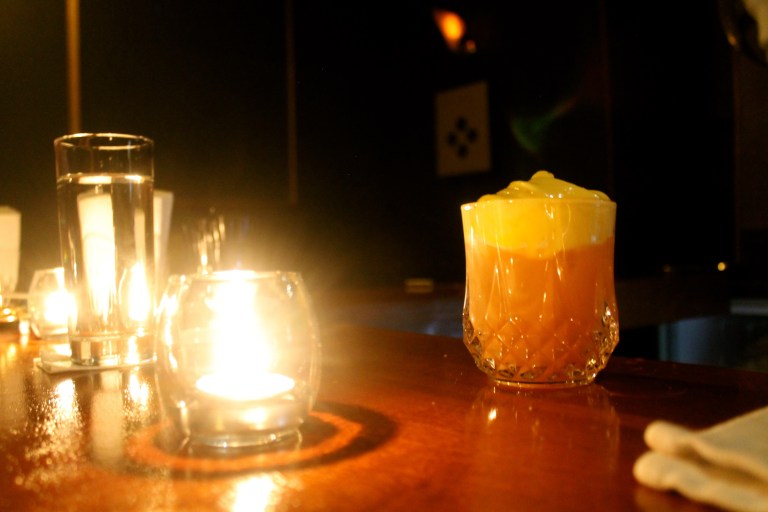 The location has changed! It’s now in the neighborhood of Quinta Camacho. Calle 69A, #10-05. No longer secreted behind the Pan Asian food restaurant, Thom Ngon, on top of Xarcuteria near Parque 93. Go up the stairs and ring on the doorbell. Someone will open the little window (just like in the prohibition movies) and let you in. Maybe. The owner says that he wants this place to stay secret and hidden so that only those who like a good hand crafted drink will hear about this place by word of mouth. He says that he doesn’t want the meat market “seen scene” (my description) types here. We shall see.
 Unlike the other